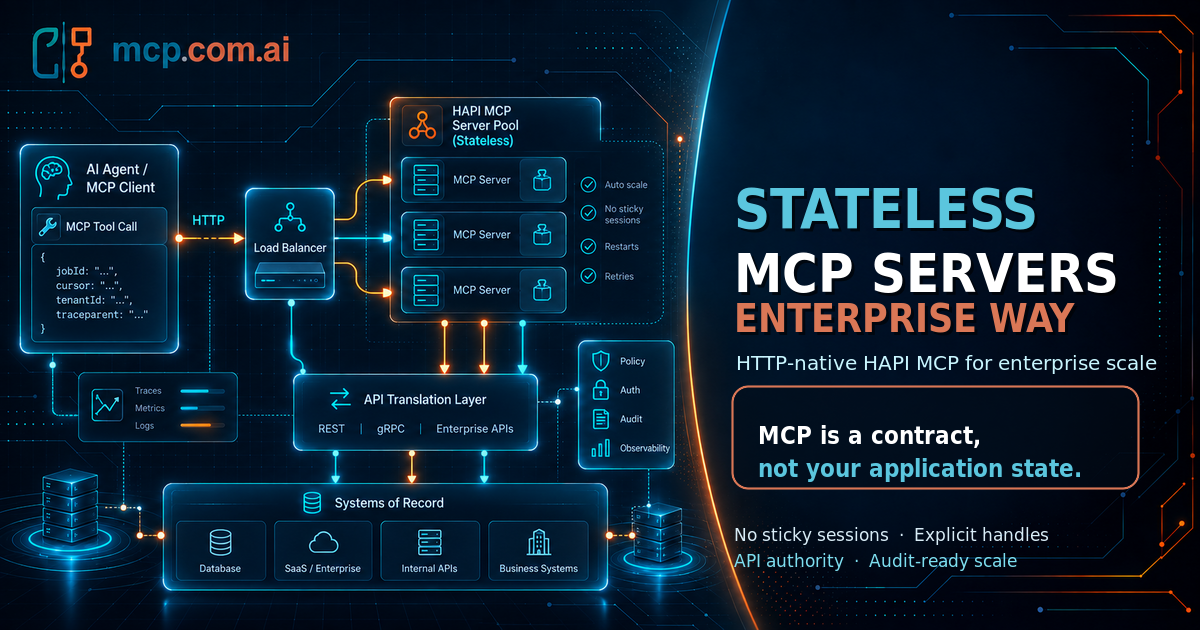
Stateless MCP Servers the Enterprise Way

The most valuable MCP server may be the one that refuses to become your application.
MCP is moving toward a clearer architectural truth: servers should be stateless.
The current MCP specification says that every request must contain the information needed to process it. Servers must process requests independently and must not infer context from an earlier request—even when requests arrive over the same connection or stream. If state must outlive one request, it needs an explicit identifier that the client sends again. MCP specification
For HAPI MCP, this is not a new feature announcement.
It is validation of a design choice.
HAPI MCP was created around a simple idea:
MCP is a contract, not a server.
That distinction matters more now than ever.
Statelessness is the architectural sibling to the MCP With No Shadows series: shadows are about where business logic lives, this is about where state lives. Both come back to the same rule — the MCP layer is an interface, not a second system of record. See also API-first vs. MCP-first for the broader thesis this post assumes throughout.
The problem: too many MCP servers became mini-applications
When teams hear "MCP server," they often start building a long-running process with hidden memory, local credentials, filesystem access, session assumptions, and business logic embedded inside it.
It can work in a demo.
Then reality arrives.
A request is retried. A container restarts. Traffic is load-balanced. An agent changes clients. A customer wants an air-gapped deployment. Security asks where credentials live. Operations asks how to trace a failed action. The conversation moves to another device.
Now the "MCP server" is no longer a simple interface. It has quietly become another application platform to secure, operate, scale, patch, and explain.
That is unnecessary technical debt when the business capability already exists behind a trusted REST or gRPC API.
The API is already where the business rules, permissions, data ownership, transactions, audit trails, and operational knowledge should live.
HAPI MCP does not ask enterprises to rebuild that foundation.
It turns the existing API contract into an AI-facing contract.
Statelessness is an enterprise design choice
Stateless does not mean that business systems have no state.
An order has a state. A customer record has a state. A long-running export has a state. A Kubernetes deployment has a state.
The difference is where that state belongs.
A stateless MCP layer does not hide it inside a process or bind it to a connection. It references the real state explicitly:
orderIdcustomerIdjobIddeploymentIdcursortaskHandle
This is not a small implementation detail. It is the difference between a reliable distributed system and a conversational illusion.
MCP’s sessionless direction formalizes the same pattern through explicit state handles: when an operation needs continuity, the server returns a handle and the client sends it again on the next request. The state is visible, portable, and controllable—not guessed from an open connection. SEP-2567
That maps naturally to well-designed APIs.
Why HAPI MCP never implemented stdio
HAPI MCP has always favored HTTP-based, headless deployment because our goal was never to turn an agent’s local machine into the center of enterprise integration.
stdio can be useful for local developer tools and personal integrations. It is not "bad."
But it introduces a different operational model: a local process, an environment that may contain credentials, a lifecycle coupled to a client runtime, and assumptions that become harder to govern at scale.
HAPI MCP was designed for a different reality:
- Existing APIs are already networked capabilities.
- Enterprise authentication and authorization belong at well-defined boundaries.
- Deployments may be public cloud, private cloud, on-premises, hybrid, or air-gapped.
- Security teams need clear control of credentials, policies, and audit trails.
- Operations teams need standard observability and scalable infrastructure.
- AI clients should be replaceable without forcing a rewrite of business integrations.
The MCP specification itself distinguishes these models: it defines authorization for HTTP-based transports, while stdio implementations typically retrieve credentials from the local environment. MCP specification
For HAPI MCP, HTTP was not an afterthought. It was the correct boundary.
MCP is the interface. APIs remain the authority.
A useful mental model is this:
| Layer | Responsibility |
|---|---|
| AI client or agent | Reasoning, conversation, intent, planning |
| HAPI MCP | Tool contract, controlled API exposure, translation, policy boundary |
| REST/gRPC API | Business capability and domain operations |
| Business system | Source of truth, transactions, durable state |
The model should reason.
The system should authorize.
The API should execute.
The database or business platform should own durable state.
HAPI MCP sits between AI consumers and existing services as a protocol adapter and capability boundary. It should not become your CRM, ERP, workflow engine, filesystem, secret vault, or replacement backend.
That approach gives teams a practical rule:
Do not move business state into MCP just because the interface is conversational.
Expose the capability. Preserve the authority.
Statelessness makes MCP easier to scale and safer to govern
When each MCP request is self-contained, the architecture gets simpler in the ways enterprises care about most.
Reliability
Any healthy instance can process a request. A restart does not erase the meaning of a conversation. A retry does not require recovering hidden server memory. A client can reconnect without reconstructing an invisible session.
Security
There is less hidden state to leak, fewer local environments carrying secrets, and a clearer place to apply OAuth/OIDC, API keys, mTLS, gateway policy, and least-privilege authorization.
HAPI MCP can preserve the API’s authentication and authorization design instead of inventing a second identity model around an agent runtime.
Observability
A request can carry correlation and trace context. The current specification includes OpenTelemetry-compatible traceparent, tracestate, and baggage metadata. MCP specification
That means an organization can follow one action across:
AI request → HAPI MCP tool call → API gateway → backend service → business system.
This is how teams prove what happened, debug failures, and audit agent-driven actions.
Portability
A stateless MCP contract can run behind a load balancer, in a Cloudflare Worker, in a container, on a private network, or inside an air-gapped environment.
That is essential for HAPI MCP’s enterprise mission: enable AI adoption without forcing customers to expose or rebuild their reliable systems.
Stateless does not mean context-free
This is the part many teams get wrong.
A stateless server can still support rich, context-aware work. The context simply has to be explicit and intentional.
Some context belongs with the agent:
- User conversation history
- The user’s goals
- Preferences
- Prior reasoning
- Plans across multiple tools
Some belongs in the request:
- Tool arguments
- Tenant or resource identifiers
- Correlation IDs
- Explicit handles for durable tasks
- Authorized identity context
Some belongs in the system of record:
- Customer data
- Inventory
- Orders
- Cases
- Policies
- Long-running job status
HAPI MCP helps maintain those boundaries. It does not pretend that one persistent MCP process should hold all of them.
The HAPI MCP position: do not rebuild what already works
The market spent its first MCP phase asking:
Can OpenAPI generate MCP tools?
Yes. That is increasingly the easy part.
The harder questions are:
- Which capabilities should an agent receive?
- Which parameters should the model control?
- What authorization is required for each action?
- Where does durable state belong?
- How do tools compose into predictable outcomes?
- How do we trace and prove an action?
- How do we support cloud, hybrid, on-premises, and air-gapped deployments?
HAPI MCP was built for those questions.
It transforms existing OpenAPI-described APIs into controlled MCP capabilities without asking organizations to replace their architecture. It supports the principle that REST and gRPC remain the systems of execution for developers, applications, and business services—while MCP becomes the contract that lets AI consumers use those capabilities safely.
Your APIs do not need to be rebuilt for AI.
They need the right interface.
The lesson for MCP builders
If your MCP server needs a long-lived hidden session to work, ask a hard question:
Is that state genuinely part of the MCP layer—or did application state leak into the integration layer?
Use explicit IDs for durable work. Keep authorization close to the protected resource. Keep business rules in business services. Keep context where it belongs. Treat each MCP call as a controlled request, not a message inside a magical private conversation.
That architecture is easier to test, easier to scale, easier to secure, and easier to trust.
For HAPI MCP, the principle remains simple:
MCP is a contract, not a server. APIs are the authority. HAPI MCP is the interpreter.
Stateless MCP is not a limitation.
It is what allows AI interfaces to become dependable enterprise infrastructure.
Frequently Asked Questions
Details
What does it mean for an MCP server to be stateless?
A stateless MCP server processes every request independently, using only the information that request itself carries, instead of inferring context from an earlier request on the same connection. If something needs to persist across requests, it's referenced by an explicit identifier — anorderId, a jobId, a task handle — that the client sends again, not held in server memory.Details
Does a stateless MCP server mean the business has no state at all?
No. Orders, customer records, and long-running jobs all have real state — it just doesn't belong inside the MCP layer. A stateless MCP server references that state explicitly through IDs and handles instead of hiding it inside a process or a connection, leaving the actual state where it already lives: the business system of record.Details
Why doesn't HAPI MCP use the stdio transport?
stdio couples an MCP server's lifecycle to a local client process and typically pulls credentials from the local environment, which is workable for personal tooling but harder to govern at enterprise scale. HAPI MCP uses HTTP-based, headless deployment instead, so authentication, authorization, and credentials stay at well-defined network boundaries regardless of deployment target — cloud, on-premises, hybrid, or air-gapped.Details
How does statelessness help an MCP server scale?
When every request is self-contained, any healthy server instance can handle it — a restart doesn't erase an in-progress conversation, a retry doesn't need to recover hidden memory, and traffic can be load-balanced freely. That's what lets a stateless MCP layer run behind a load balancer, in a container, or at the edge, with the same behavior every time.Details
What is MCP's sessionless direction / explicit state handles?
It's a pattern where, if an operation needs to continue across multiple requests, the server returns an explicit handle and the client sends that same handle back on the next request — rather than the server inferring continuity from an open connection. The state becomes visible and portable instead of implicit, which is exactly what a stateless MCP layer needs to support genuinely long-running work.See the same principle applied to business logic, not just state, in the MCP With No Shadows series — starting with why duplicated business logic breaks trust.