The Codex Desktop App: A Paradigm Shift in Developer Tooling

Something subtle but massive just happened in developer tooling. The IDE Is No Longer the Center of Development — Agent Orchestration Is.
For decades, the IDE was the center of software development. Everything revolved around it: edit → run → debug → commit.
Now something else is emerging.
A control plane for AI agents.
The Quiet Shift: From AI Assistants to AI Teams
For the past few years, most AI coding tools followed a simple pattern:
Developer + AI assistant
Think of tools like Copilot or inline AI suggestions.
You write the code. The AI helps.
But the Codex app introduces a different model entirely.
Instead of one assistant, you manage multiple AI agents working in parallel.
Example workflow:
- Agent 1 implements a new feature
- Agent 2 writes unit tests
- Agent 3 refactors the database layer
- Agent 4 reviews the changes
All happening simultaneously on the same codebase.
Each agent runs in its own isolated environment, often using Git worktrees to avoid conflicts.
Your job is no longer to write every line.
Your job becomes orchestrating the work.
The Codex App: A Command Center for Software Development
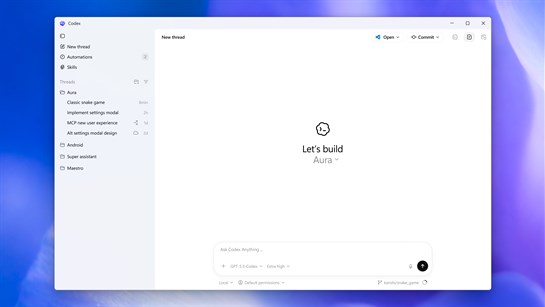
OpenAI describes the Codex app as a command center for agentic coding where multiple tasks run across projects in parallel.
Instead of working file-by-file, developers can:
- spin up agents for tasks
- monitor progress across projects
- review diffs generated by agents
- approve or reject changes
- automate long-running development tasks
The system organizes agents into threads and projects so you can track work across many workflows at once.
In other words:
You manage software production, not just code editing.
Why This Matters More Than It Looks
The real disruption isn’t the tool.
It’s the change in the developer role.
Traditionally:
Human writes code
AI helps with autocomplete
Now:
Human orchestrates agents
Agents write most of the code
The human moves up a level of abstraction.
From implementation → coordination.
This is similar to how DevOps changed operations:
- admins stopped managing individual servers
- they orchestrated infrastructure with automation
Now developers may stop writing every line and start orchestrating intelligent workers.
The IDE Is Becoming Secondary
One of the most interesting signals from early Codex users is that some projects were completed without opening an IDE at all.
The workflow looked like:
- Define tasks
- Launch agents
- Review diffs
- Merge results
The IDE becomes a verification environment, not the main workspace.
Or as some engineers are starting to describe it:
The IDE is where code gets reviewed, not where it gets written.
A New Category of Dev Tools Is Emerging
We are entering a new category of developer infrastructure:
Agent orchestration platforms.
Think about the layers forming:
Layer 1 — Models
LLMs capable of coding and reasoning.
Layer 2 — Agents
Autonomous systems executing tasks.
Layer 3 — Orchestration
Tools coordinating many agents together.
Layer 4 — Interfaces
Control panels for supervising the system.
The Codex desktop app sits in layer 3 and 4.
And that’s where the biggest opportunities may appear.
Why This Matters for the AI Ecosystem
If agents become the primary actors in development, something else becomes critical:
Standardized ways for agents to access tools, APIs, and data.
Agents don’t just write code.
They need to:
- query APIs
- access services
- interact with infrastructure
- call tools
- coordinate with other agents
This means the future dev stack likely needs:
- agent-native APIs
- standardized tool interfaces
- structured orchestration protocols
Without that, every agent ecosystem becomes fragmented.
The Bigger Pattern: Agent Operating Systems
What we’re starting to see is the early version of something bigger:
Agent operating systems.
Where the developer:
- assigns goals
- delegates tasks
- supervises execution
And the agents perform the work.
This pattern is emerging across tools:
- AI coding agents
- research agents
- automation agents
- DevOps agents
The orchestration layer becomes the new control plane of software development.
The Role of Developers in the Agent Era
The developer role is evolving.
Not disappearing.
But changing.
Instead of:
👨💻 writing code all day
Developers increasingly become:
🧑✈️ supervisors of intelligent systems
They define architecture, intent, and constraints.
The agents implement.
The Next Generation of Developer Tools
If this trajectory continues, developer tooling may look very different in the next few years.
Instead of:
Editor
Terminal
Debugger
We may see tools centered around:
Agent dashboards
Task orchestration
Workflow supervision
Execution logs
Diff approval systems
Less editing.
More orchestration.
The Bigger Question
The real question now isn’t whether AI will write code.
That’s already happening.
The real question is:
Who controls the agents?
Because once agents become the workers of software development, the most important infrastructure becomes:
- orchestration layers
- agent ecosystems
- tool interoperability
And that’s where the next generation of developer platforms will compete.
Final Thought
We are moving from:
👨💻 developer + AI assistant
to
🧑✈️ developer supervising a team of AI agents.
And if that continues, the tools we use will change accordingly.
The next generation of dev tooling will likely look less like editors…
and more like control panels for agent workflows.