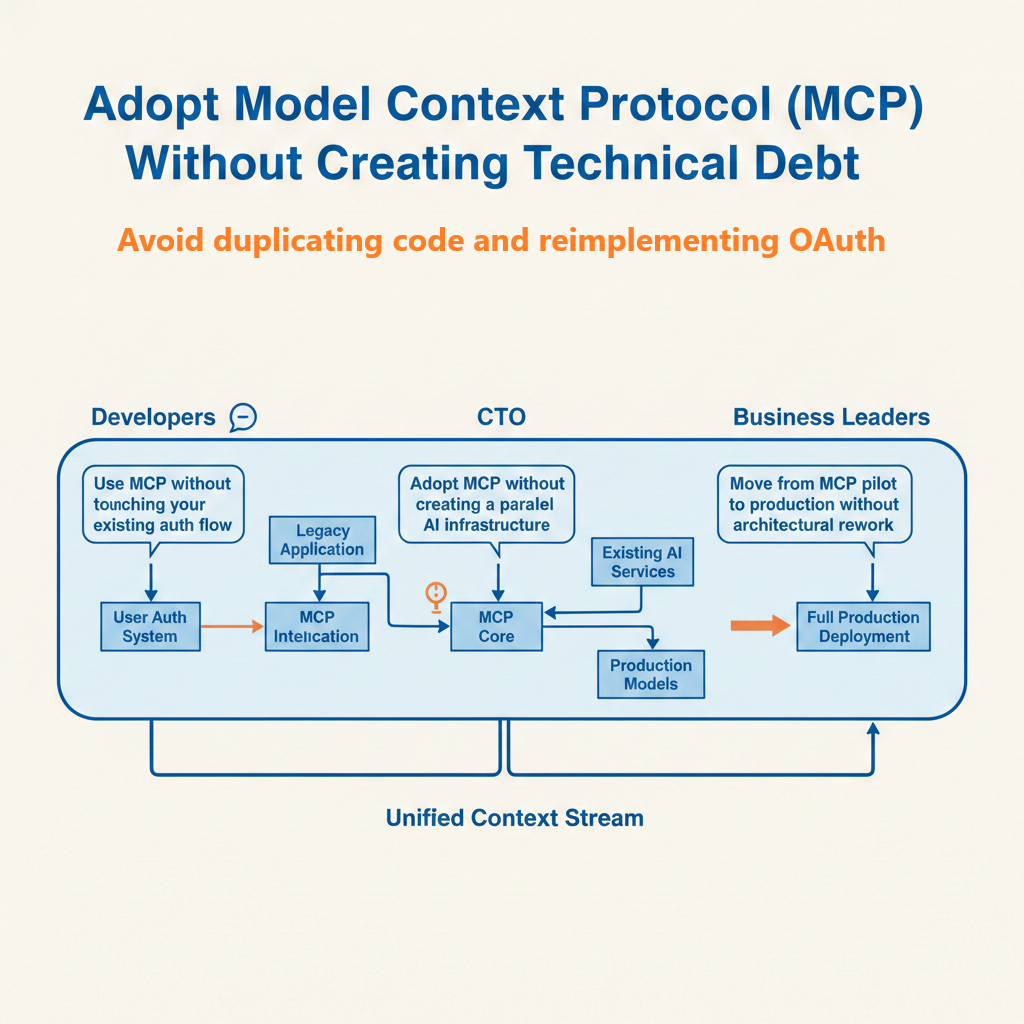
How to Adopt MCP Without Creating Technical Debt

Everyone wants AI agents. No one wants AI debt.
MCP enthusiasm is real. Enterprise constraints are also real.
Security. Auth. Compliance. Deployment pipelines. Audit logs. None of that disappears because we’re excited about agents.
The hard truth? Most teams building MCP servers today are moving fast — and quietly laying the foundation for the next generation of technical debt.
This is where the conversation needs to change.
This is where HAPI MCP enters.
What Is MCP—and Why Enterprises Are Paying Attention?
Model Context Protocol (MCP) is emerging as the standard way to connect AI models to tools, APIs, and systems in a structured, secure way.
In simple terms:
MCP lets AI safely call your APIs.
For enterprises, that’s powerful. It means:
- AI agents interacting with internal systems
- Chat interfaces becoming operational tools
- Automation powered by real business APIs
But here’s the catch:
The excitement around MCP is developer-driven. The constraints around adoption are enterprise-driven.
If you ignore the second, you create invisible risk.
The Real Villains in MCP Adoption
🚫 Reinventing Infrastructure
Most teams building MCP servers today are reimplementing OAuth.
It works... Until you need:
- Token rotation
- Scope management
- Audit logging
- Cross-environment policies
- Compliance validation
Now your “quick integration” becomes a parallel security stack.
That’s not innovation. That’s duplication.
🚫 Breaking Existing Deployment Models
Some MCP implementations assume:
- New deployment pipelines
- Separate AI infrastructure
- Special server environments
That might work in a startup lab.
In enterprise environments? That’s friction. And friction kills adoption.
🚫 Creating AI-Specific Silos
When AI integrations live outside your existing architecture, you create:
- Separate auth
- Separate logging
- Separate deployment
- Separate ownership
- Separate codebases - and therefore separate maintenance
Silos become permanent. They become “that AI thing” that no one wants to touch.
🚫 Invisible Technical Debt
This is the dangerous one.
AI pilots often “work.” But they bypass enterprise guardrails to move fast.
Months later, someone asks:
- Can we audit this?
- Can we scale this?
- Can we support 10 teams using it?
- Can we pass a security review?
If the answer is “not without rework,” you’ve created invisible debt.
🚫 AI Pilots That Can’t Scale
The biggest failure pattern:
- Cool demo
- Executive excitement
- Security review
- Architectural rethink
- Restart from scratch
That’s not speed. That’s waste.
The Shift: You Don’t Need a New AI Infrastructure
Here’s the mindset change:
You don’t need a new auth system for AI. You don’t need a new deployment model for MCP. You don’t need an AI silo.
You need MCP that respects your existing stack.
That’s the difference.
Introducing HAPI MCP: The Stack That Respects Your Stack
HAPI MCP is designed around one principle:
Adopt MCP without creating technical debt.
Instead of replacing your architecture, HAPI:
- Plugs into your existing authentication
- Aligns with your current deployment pipelines
- Works within your compliance model
- Avoids creating AI-specific infrastructure
You move fast — without breaking what already works.
How HAPI MCP Eliminates Technical Debt
The traditional approach involves reimplementing OAuth, duplicating code for token management, and building custom audit logging. This works temporarily—until you need to rotate tokens, manage scopes, or scale across environments.
Suddenly, you're maintaining a custom security infrastructure.
With HAPI MCP, you don’t need a new auth system or logic for AI.
HAPI MCP plugs directly into your existing auth and deployment flow.
Which means:
- Faster shipping
- Lower security risk
- Real enterprise adoption
- Reduced long-term maintenance cost
That’s the difference between a demo and a platform.
HAPI MCP in an Enterprise Context
HAPI integrates with what you already run.
Not what you wish you ran. Not what a greenfield startup runs.
Your stack.
This includes:
- Existing OAuth or OIDC providers
- Existing API gateways
- Existing deployment pipelines
- Existing cloud or on-prem models
No new auth layer. No new deployment model. No AI silo.
Just MCP layered cleanly into your architecture.
Why This Matters
Ship MCP Without Rewriting Everything
The most common blocker for MCP adoption is the fear of extensive rework. HAPI eliminates this by enabling you to:
Use MCP without touching your existing auth flow.
You focus on filtering and exposing APIs to AI—not reinventing security. HAPI handles the integration alignment, resulting in less friction, fewer security escalations, and faster delivery.
Avoid Parallel AI Infrastructure
Building a separate MCP server with its own auth and deployment creates a parallel system that’s invisible to your security and platform teams. This introduces shadow infrastructure, bypasses compliance, and creates long-term maintenance costs.
The key concern isn’t “Can we build this?”
It’s:
Are we creating infrastructure we’ll regret in 18 months?
HAPI ensures:
- AI integrations sit inside your governance model
- No shadow infrastructure
- No compliance bypass
- No parallel auth systems
Adopt MCP without creating architectural debt.
From Pilot to Production
Is it possible to build a quick MCP pilot that scales to 20 production use cases?
The risk isn’t failure. The risk is rework.
When MCP is built in isolation, scaling requires redesign.
With HAPI:
- Pilot → Production is incremental
- No architectural rewrite
- Faster path to measurable ROI
You move from experimentation to operational AI — safely.
MCP Enthusiasm Is High. Enterprise Constraints Are Real.
Let’s address the tension directly.
Yes, MCP unlocks:
- Agent-driven workflows
- AI-powered automation
- Tool orchestration
- Intelligent operations
But enterprises cannot ignore:
- Security models
- Compliance frameworks
- Deployment standards
- Audit requirements
The organizations that win will not be the fastest experimenters.
They will be the fastest safe adopters.
FAQ: Adopting MCP Without Technical Debt
What causes technical debt in MCP implementations?
- Reimplementing authentication
- Creating AI-specific infrastructure
- Bypassing existing deployment models
- Ignoring compliance and audit alignment
Can MCP integrate with existing OAuth systems?
Yes. A properly designed MCP stack should plug into your current OAuth/OIDC provider instead of replacing it for one-off AI integrations.
How do you scale MCP from pilot to production?
By ensuring:
- Zero code duplication
- Auth reuse
- Deployment reuse
- Governance alignment
- Observability integration
If those are separate, scaling requires rework.
Why do AI pilots fail to scale?
Because they’re built outside enterprise architecture guardrails.
When security and platform teams get involved, redesign becomes mandatory.
The Business Case: Speed Without Risk
Let’s translate this into enterprise language.
Cost Avoid duplicating infrastructure and future rework.
Risk Align AI integrations with existing governance from day one.
Time-to-Market Ship MCP integrations in hours — not months of security negotiation.
Scalability Move from 1 pilot to 20 production use cases without architectural reset.
That’s how you move fast — without creating debt.
The Bottom Line
You can move fast and safely.
You can ship MCP integrations in hours.
You can avoid rewriting auth, deployments, or workflows.
You can adopt MCP without creating a parallel AI infrastructure.
But only if your MCP stack respects your existing stack.
That’s the shift.
That’s the relief.
And that’s why HAPI MCP is positioned not as “another MCP tool” — but as the enterprise-ready stack for sustainable AI adoption.
Because the real goal isn’t to launch an AI demo.
It’s to build AI capability without architectural regret.