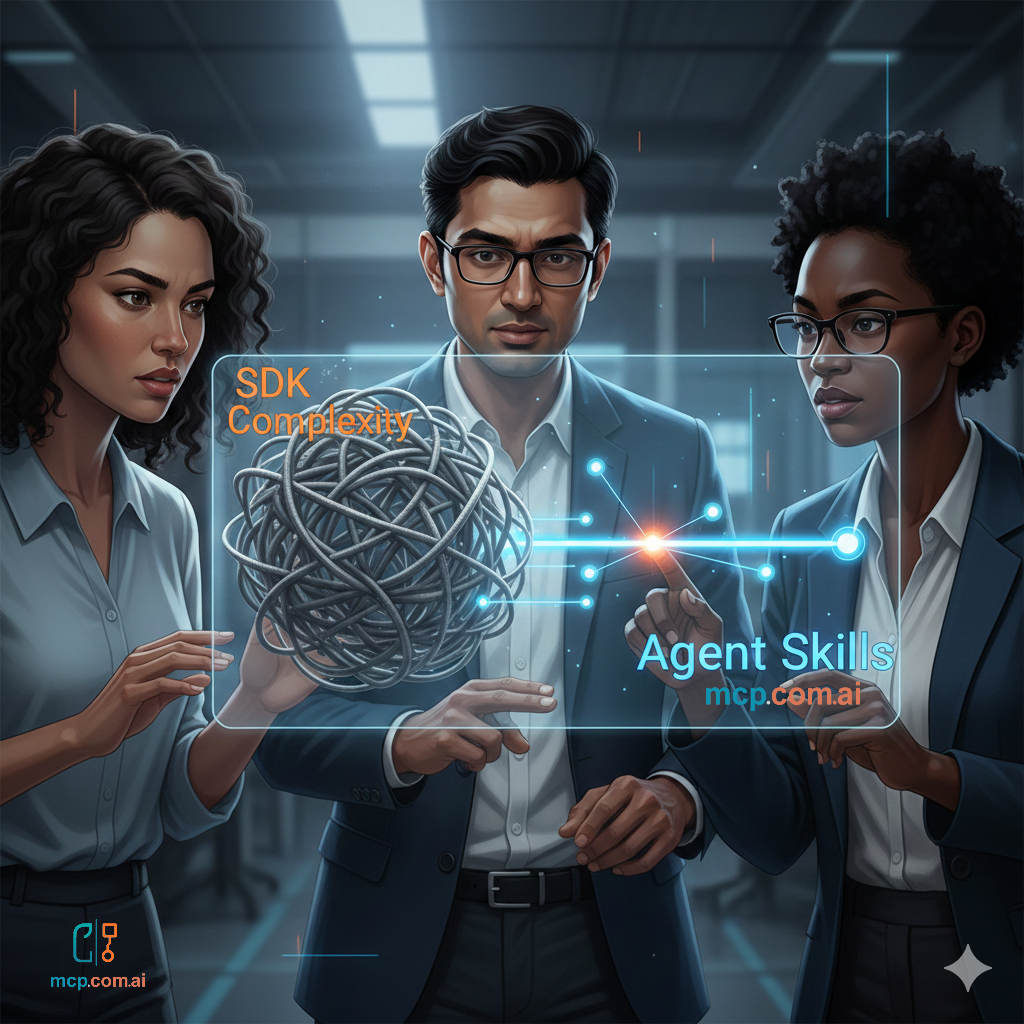
SDKs are Dead: Embracing Agent Skills for Automation

What's the lesson from Brian Casel's experience about the future of SDKs, no-code workflows, and automation?
In short: SDKs are dead - well, at least for many use cases in modern application development.
Brian Casel, a well-known developer and entrepreneur, shared his experience building an AI-powered image generation automation. He spent a full week constructing a complex automation in n8n (a popular no-code workflow engine) for AI image generation — but ultimately scrapped it and rebuilt the entire thing as a Claude Code Skill instead.
His conclusion? Claude Code Skills are better suited for flexible, maintainable, and powerful automations than traditional no-code workflows for many use cases.
Why SDKs Are Dying
In the age of Agentic AI, traditional Software Development Kits (SDKs) are becoming increasingly obsolete for many applications. Here's why:
The Problem with SDKs:
- SDKs are rigid structures that require extensive coding to handle various scenarios
- They lock developers into specific implementation patterns
- Updates and changes require manual code rewrites
- Error handling and edge cases multiply code complexity
- As Brian Casel demonstrated, even no-code platforms like n8n can become complex, brittle, and hard to maintain when building sophisticated automations
The Agentic AI Advantage:
Claude Code Skills and similar agentic approaches flip this model on its head. Instead of prescribing exactly how to accomplish a task, you define:
- High-level goals and constraints
- What success looks like
- The AI reasons about the best approach dynamically
This shift from static, deterministic code to intelligent reasoning means applications can evolve and respond to new challenges without constant manual updates.
Anthropic did it again. Just as they revolutionized the AI-API landscape with the Model Context Protocol (MCP) and MCP Servers, they're now pioneering how we build automations and applications with Agent Skills.
How to Build with Agentic AI
To leverage the power of Agentic AI, developers should focus on these key principles:
1. Goal-Oriented Design
Define what the application should achieve rather than how to achieve it step-by-step. This allows the AI to determine the best course of action based on context and constraints.
2. Dynamic Adaptation
Utilize AI's ability to adapt to new inputs and scenarios. This reduces the need for:
- Hard-coded logic branches
- Extensive conditional statements
- Manual handling of edge cases
3. Continuous Learning
Implement feedback loops where the AI can learn from its actions and improve over time, enhancing the application's performance and reliability.
4. Integration with AI Services
Leverage existing AI platforms and services that offer agentic capabilities, reducing the need to build complex systems from scratch.
5. Focus on User Experience
With AI handling the complexity, developers can concentrate on creating intuitive and engaging user experiences.
Real-World Examples of Agentic AI
Agent Skills in Action
As demonstrated by Brian Casel, Claude Code Skills allow for building flexible automations that can adapt to changing requirements without extensive rewrites.
Community Examples from mcp.com.ai skills:
- API To MCP - Automates the conversion of REST APIs and deployment into MCP Servers without writing SDK code
- Test Remote MCPs - Automates testing of remote MCP servers without SDK dependencies or language-specific requirements
Community-Built Skills:
- Automating content generation workflows
- Dynamic data processing pipelines
- Intelligent customer support systems
Other AI Services
- Code Copilots: AI-powered coding assistants that help developers write code faster with fewer errors
- Custom AI Agents: Tailored agents for specific tasks or workflows. Examples:
- The
HAPI MCP Visual Identity System Agent- Helps maintain and enhance visual identity systems, creating assets dynamically without rigid templates (inspired by Brian's example) - VS Code AI Agents - Assist in code generation, debugging, and optimization
- The
- AI-Powered APIs (MCP Servers): APIs that leverage AI to provide intelligent responses and actions, eliminating the need for complex SDKs
The Future is Agentic
The future of application development lies in embracing Agentic AI. As traditional SDKs become less relevant, anyone building software—whether developers or non-developers—must adapt to this new paradigm by focusing on:
- High-level goals instead of step-by-step instructions
- Dynamic adaptation over rigid code structures
- Continuous learning rather than static implementations
By doing so, they can build smarter, more resilient applications that evolve with changing needs and challenges.
Creating systems that can think and adapt on their own unlocks new possibilities not only in software development but across industries and specialized domains.
The Five Pillars of Agentic Success:
- Design - Think in goals, not steps
- Adapt - Let AI handle variations
- Learn - Improve through feedback
- Integrate - Leverage existing AI services
- Evolve - Continuously refine based on outcomes
Agility, innovation, and flexibility are the cornerstones of successful applications in the age of Agentic AI. This shift clearly indicates that the era of rigid SDKs is coming to an end. The future belongs to those who can harness the power of Agentic AI to create flexible, intelligent systems that can think and adapt independently.
The Reality Check
Don't get me wrong—SDKs aren't entirely dead yet. They'll probably remain relevant for another decade or more in certain scenarios:
- Low-level system programming where direct hardware control is needed
- Performance-critical applications like game development and real-time systems
- Embedded systems with strict resource constraints
- Enterprise software with rigid compliance and certification requirements
- Specialized domains with deterministic behavior requirements
However, for modern web applications, automations, and business logic—areas requiring flexibility and adaptability—Agentic AI with Agent Skills offers a superior alternative.
Key Takeaways
Teams and developers should embrace new technologies and paradigms that enhance productivity and innovation. By shifting focus from rigid SDKs to dynamic, goal-oriented AI systems, people can:
- ✅ Build more maintainable systems
- ✅ Reduce time spent on edge cases and error handling
- ✅ Create applications that adapt to user needs automatically
- ✅ Focus on user experience instead of implementation details
- ✅ Unlock new possibilities in automation and integration
Rebels, take note: the future is agentic, and it's time to adapt.
Be HAPI, and Go Rebels! ✊🏼
FAQ: Agent Skills and the Future of SDKs
Q: Are SDKs really dead?
A: Not completely—they'll remain relevant for low-level programming, game development, and compliance-heavy enterprise software. But for most modern applications needing flexibility, Agentic AI offers better alternatives.
Q: What are Agent Skills?
A: Agent Skills are capabilities that enable AI agents to perform tasks by reasoning about goals rather than following rigid code. You define what should happen; the AI figures out how.
Q: How do Agent Skills differ from traditional SDKs?
A: SDKs require extensive coding for every scenario with static logic. Agent Skills use AI to reason and adapt dynamically, responding to new challenges without manual updates.
Q: Can I replace my existing automations with Agent Skills?
A: Yes! Brian Casel demonstrated this by replacing his week-long n8n workflow with a Claude Code Skill. Check platforms like skills.sh for examples of Skills replacing SDK implementations.
Q: What is the Model Context Protocol (MCP)?
A: MCP is Anthropic's standard that revolutionized AI-API interactions. MCP Servers provide AI-powered API interfaces, reducing the need for complex SDKs and manual integration work.
Q: What are the benefits of Agentic AI over traditional development?
A: Goal-oriented design, dynamic adaptation, continuous learning, easier integration, and focus on user experience. This results in more maintainable and adaptable applications.
Q: How do I get started with Agent Skills?
A: Define high-level goals for your application instead of step-by-step instructions. Explore Claude Code Skills and browse community-built Skills at agentskills.io or skills.sh.
Q: Will SDKs be completely replaced by AI?
A: Not for another decade or more in domains like game development, embedded systems, and highly regulated software. But for most modern web apps and automations, agentic approaches are becoming the preferred choice.