Do Not Rebuild a Reliable Platform for AI: How Milano Software Is Accelerating AI Adoption
The expensive part of enterprise AI is often not the model. It is rebuilding what already works.
Many software companies have spent years, and sometimes decades, turning business rules, customer needs, operational lessons, security controls, and hard-won reliability into production APIs.
Then AI arrives, and the first instinct is often: We need to rebuild the platform for agents.
That can be a costly mistake.
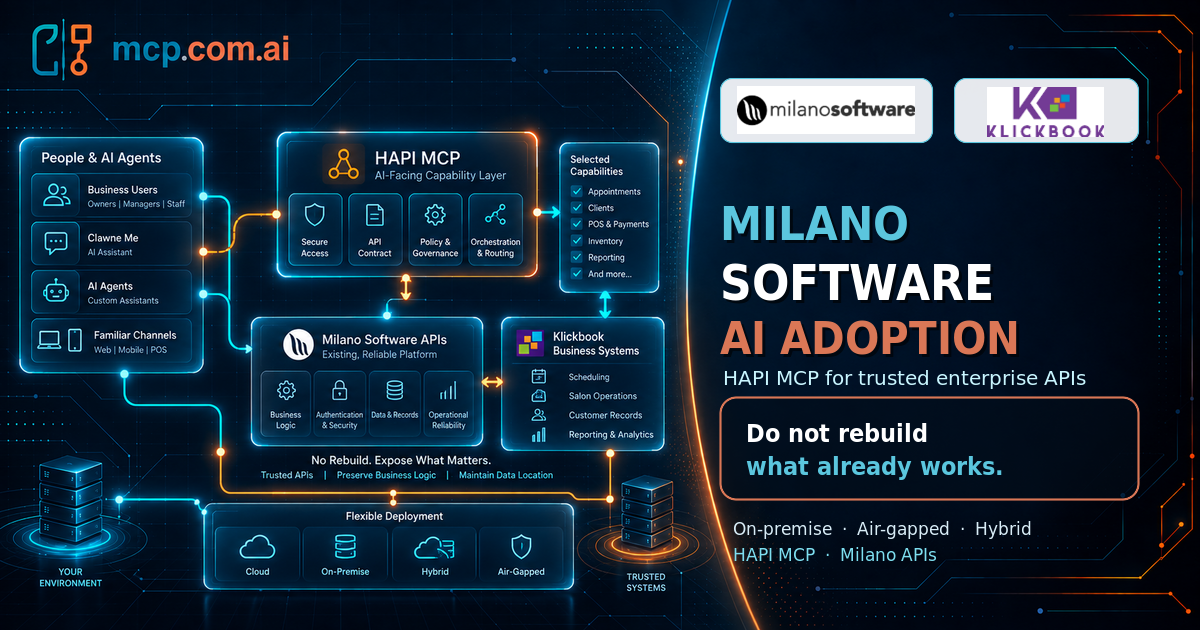
Milano Software is taking a more practical path. Instead of replacing its reliable API platform to make it useful to AI, the company is exploring how to expose selected capabilities through the Model Context Protocol (MCP). HAPI MCP provides the bridge.
The goal is not to make the APIs obsolete. The goal is to make them HAPI: accessible to AI consumers while preserving the platform, business logic, and deployment model Milano already trusts.
This collaboration has also been an important source of real-world feedback and validation for HAPI MCP version 0.8, especially for enterprise environments where "just deploy it in the public cloud" is not a valid answer.
The business lesson: AI adoption should compound previous investments
Milano Software provides business management technology for salons, spas, fitness businesses, retail operations, and other service-based companies. Its public product portfolio covers capabilities such as appointment booking, customer relationship management, point of sale, inventory, reporting, payments, and marketing. Its Klickbook platform extends that experience through a cloud-based booking and business management solution. (Milano Software, Klickbook)
Those capabilities represent more than endpoints.
Behind each API operation are years of decisions:
- What information is required to create an appointment?
- Which staff members can provide a service?
- How should inventory change after a sale?
- What happens when a booking is moved or cancelled?
- Which customer, payment, or operational rules must always be enforced?
That is where the real value lives.
Rebuilding those capabilities in a separate "AI-native" platform would not automatically create more intelligence. It could create duplicated logic, inconsistent behavior, new security boundaries, more systems to operate, and another place where defects can hide.
In business terms, that means more cost, more risk, and a longer road to customer value.
The better question is:
How can an AI application use the trusted capabilities that already exist?
That is the problem HAPI MCP is designed to solve.
What does it mean to make an API "HAPI"?
Making an API HAPI does not mean translating every endpoint into an MCP tool and dropping the entire catalog into an agent’s context.
It means creating a controlled AI-facing capability layer over the existing API estate.
MCP is an open standard that connects AI applications with external systems. An MCP server can expose tools that allow a model to retrieve information, invoke an API, or perform an action through a defined schema. (MCP introduction, MCP tools specification)
HAPI MCP builds on that model with an API-first principle:
MCP is a contract for AI consumers, not a reason to replace the service behind the contract.
The existing API remains the system interface. It continues to serve web applications, mobile applications, integrations, automation, and developers. HAPI MCP adds an interface designed for AI clients and agents.
This separation matters because APIs and MCP serve related but different consumers:
| Interface | Primary consumers | Main concern |
|---|---|---|
| REST or gRPC API | Applications, integrations, developers, automation | Predictable programmatic access |
| MCP server | AI hosts, assistants, and agents | Discoverable, contextual, controlled tool use |
| Clawne Me | Business users interacting through familiar channels | Delegating outcomes without managing AI infrastructure |
One does not need to replace the others. They can work as layers of the same architecture.
Why not expose every API operation to the agent?
Milano has many APIs and many possible AI use cases. That creates opportunity, but it also creates an important design challenge.
An API catalog is usually organized for software developers. An AI agent does not navigate that catalog the same way a developer does.
If hundreds of narrowly defined operations are exposed at once, the model must spend more context and reasoning capacity deciding which tool to use. Similar tools may compete with one another. Tool descriptions become more difficult to distinguish. The probability of selecting the wrong operation, or supplying the wrong arguments, can increase.
The shortcut is not "convert everything."
The shortcut is to start with a valuable business intent and expose only the capabilities required to fulfill it.
For example, a future scheduling assistant may need to:
- Identify a customer.
- Find eligible services and staff;
- check real availability;
- create or modify an appointment; and
- return a clear confirmation.
The underlying platform may use several API calls to complete that work. The AI consumer should not necessarily be forced to understand every internal step.
HAPI MCP can present a smaller, purpose-built tool surface aligned with the user’s intent while allowing Milano’s existing APIs to remain the source of truth.
This is context engineering, not merely protocol conversion.
How does HAPI MCP reduce the cost and risk of enterprise AI adoption?
1. It protects the investment already made in APIs
Reliable APIs contain proven business logic. Reusing them avoids creating a second implementation that must be developed, tested, secured, documented, monitored, and maintained.
The business impact is direct: less duplicated engineering and a shorter path from AI experiment to working capability.
2. It creates a controlled boundary for AI
An AI model should not receive unrestricted access to every internal operation simply because the API exists.
The MCP layer can expose a curated set of tools for a specific role or use case. Teams can decide what the agent is allowed to see, which actions it can request, and which capabilities should remain unavailable.
That makes the AI surface deliberate instead of accidental.
3. It supports incremental delivery
Milano does not need to complete every AI use case before delivering the first one.
The roadmap can move capability by capability:
- select one meaningful user outcome;
- identify the trusted APIs behind it;
- expose a focused MCP toolset;
- test how agents behave;
- validate with real stakeholders; and
- expand based on evidence.
Each use case becomes a manageable product decision, not a platform rewrite.
4. It keeps deployment choices open
Enterprise software does not live in one universal environment. Some customers use public cloud services. Others require on-premise deployment, hybrid integration, or networks with limited or no external connectivity.
HAPI MCP was designed from day zero with these enterprise realities in mind. The MCP layer can run close to the APIs and data it needs to access, including on-premise and air-gapped environments. It can also support public-cloud and hybrid architectures where those models fit the organization.
This is strategically important: AI enablement should not force a customer to abandon its infrastructure, security posture, or data-location requirements.
5. It creates an architecture that can evolve
MCP is becoming an important interface for AI applications, but it is still one part of a broader software architecture.
Keeping the underlying APIs intact preserves optionality. Milano can serve today’s AI assistants, tomorrow’s agents, conventional applications, partner integrations, and deterministic workflows without betting the entire platform on one interaction model.
Why on-premise and air-gapped AI matter
Public demonstrations of AI often assume three things: the application can reach the internet, the data can leave the environment, and a managed cloud service can be added without friction.
Enterprise deployments are not always that simple.
An on-premise or air-gapped environment may exist because of privacy obligations, customer contracts, security policy, latency, system dependencies, or operational control. These are not edge cases to dismiss. They are architecture requirements.
This changes the AI adoption conversation.
The question is no longer only, "Which model should we use?" It becomes:
- Where will the model run?
- Where will the MCP server run?
- Can tool execution remain inside the trusted boundary?
- How will authentication and authorization be enforced?
- What information can enter the model context?
- How will actions be logged and reviewed?
- Can the solution operate when external services are unavailable?
HAPI MCP cannot make governance decisions on behalf of an enterprise. It can, however, provide an architecture that respects those decisions instead of assuming them away.
That distinction is essential for companies like Milano Software, whose platform must work in the environments its customers actually operate.
What did Milano Software validate in HAPI MCP 0.8?
The most valuable product feedback rarely comes from a perfect demo. It comes from applying a product to a real platform with real constraints, numerous APIs, and a roadmap that must produce business value.
Through my collaboration with Imran Zalfackruddin, CEO of Milano Software, HAPI MCP 0.8 has benefited from feedback grounded in those realities.
The collaboration has reinforced several principles behind HAPI MCP:
- Enterprises need a path to AI that builds on their reliable APIs.
- MCP tools should be organized around use cases and user intent.
- Large API estates require curation and progressive exposure.
- On-premise and air-gapped deployment cannot be treated as an afterthought.
- Cloud, on-premise, and hybrid environments should be architecture choices, not product limitations.
- Feedback from API owners is as important as feedback from AI developers.
This validation is meaningful because Milano is not evaluating MCP as an isolated technology experiment. MCP is part of a larger plan to evolve an established software platform toward AI-enabled solutions.
That is exactly the environment HAPI MCP is intended to support.
Where does Clawne Me fit?
HAPI MCP makes trusted software capabilities accessible to AI. Clawne Me focuses on making those AI capabilities accessible to people.
This is an important separation.
A business owner should not need to understand API paths, JSON schemas, MCP transports, model configuration, or agent infrastructure to ask for an outcome.
They should be able to say:
- "Find open appointment times for Friday afternoon."
- "Which products need to be reordered this week?"
- "Summarize yesterday’s sales and cancellations."
- "Follow up with customers who missed their appointments."
The user interacts with a specialized Clawne through a familiar channel. The Clawne interprets the request. HAPI MCP provides the controlled connection to the business capabilities. Milano’s APIs execute the trusted logic.
The stack becomes:
People → Clawne Me → HAPI MCP → Milano APIs → Business systems
Each layer has a clear responsibility:
- Clawne Me simplifies delegation and human–AI interaction.
- HAPI MCP provides the contextual and controlled AI interface.
- Milano APIs preserve business logic and reliable execution.
- La Rebelion Labs develops and shares the practical architecture patterns behind this approach.
Together, they demonstrate a broader idea: enterprise AI becomes more useful when it meets businesses where they already are.
What should other API-first companies learn from this collaboration?
Do you need to rebuild your platform to become an AI company?
No. In many cases, rebuilding is the slower and riskier path. If the current APIs reliably expose valuable business capabilities, add an AI-facing layer before considering a replacement.
Should every endpoint become an MCP tool?
No. Begin with user intent. Expose a focused set of tools required for one outcome, validate agent behavior, and expand deliberately.
Is MCP only for public-cloud AI?
No. MCP servers can run locally or remotely. The correct topology depends on security, data, connectivity, and operational requirements. The official MCP architecture explicitly supports local and remote server models. (MCP architecture overview)
Does MCP replace REST or gRPC?
It should not have to. REST and gRPC remain strong interfaces for applications and developers. MCP provides a complementary contract designed for AI consumers.
What is the best first AI use case?
Choose a task that is valuable, bounded, measurable, and already supported by reliable APIs. Avoid beginning with the largest possible autonomous agent. Start with a capability where success and failure are easy to observe.
The bigger idea: preserve reliability while changing the interface
AI changes how people can interact with software. It does not erase the need for trusted business logic, security, predictable execution, observability, or operational discipline.
That is why Milano Software’s approach matters.
The company is not treating its existing platform as technical debt that must be discarded before AI can begin. It is treating its APIs as strategic assets that can be made available to a new class of consumer.
HAPI MCP provides the shortcut, not by skipping architecture, but by avoiding unnecessary reinvention.
There is still serious work ahead. Milano has many APIs and use cases on its roadmap. Each capability must be designed, scoped, secured, tested, and validated. But the path is now clearer:
- Keep the reliable platform.
- Select the business outcome.
- Curate the required API capabilities.
- Expose them through HAPI MCP.
- Connect them to the right AI experience.
- Learn, validate, and expand.
That is a more responsible way to accelerate AI adoption, and a more sustainable way to become an AI-enabled software company.
Thank you, Milano Software and Imran
I want to thank Milano Software and Imran Zalfackruddin for the feedback, practical challenges, and validation they have contributed to HAPI MCP 0.8.
Building an enterprise-ready product requires more than implementing a protocol. It requires listening to organizations that have reliable platforms, real customers, demanding environments, and meaningful AI roadmaps.
This collaboration is helping HAPI MCP become stronger for on-premise, air-gapped, hybrid, and public-cloud use cases.
And it confirms the principle that started this work:
Your APIs do not need to be replaced to participate in the AI era. They need the right interface for AI.
That is how we make APIs HAPI.
Suggested SEO metadata
SEO title: Milano Software Accelerates Enterprise AI Adoption with HAPI MCP
Meta description: Learn how Milano Software is using HAPI MCP to connect reliable enterprise APIs with AI across on-premise, air-gapped, hybrid, and cloud environments, without rebuilding its proven platform.
Primary keyword: enterprise AI adoption with HAPI MCP
Secondary keywords: API to MCP, enterprise MCP server, on-premise MCP, air-gapped AI, Milano Software AI, Model Context Protocol, Clawne Me, La Rebelion Labs
Suggested LinkedIn post
The fastest path to enterprise AI may be the platform you already have.
Milano Software has spent years building reliable APIs around real business operations: appointments, customers, inventory, payments, reporting, and more.
Rebuilding that platform "for AI" would duplicate logic, add risk, and delay value.
Our collaboration is exploring a better path: preserve the APIs and make selected capabilities available to AI through HAPI MCP.
This work has provided valuable feedback and real-world validation for HAPI MCP 0.8, especially for on-premise and air-gapped environments. Public cloud and hybrid deployments remain options, but they should be choices, not requirements.
Thank you to Milano Software and Imran Zalfackruddin for helping us test the principle behind HAPI MCP:
Your APIs do not need to be replaced to participate in the AI era. They need the right interface for AI.
That is how we make APIs HAPI.
#HAPIMCP #ModelContextProtocol #EnterpriseAI #APIs #AgenticAI #ClawneMe #LaRebelionLabs