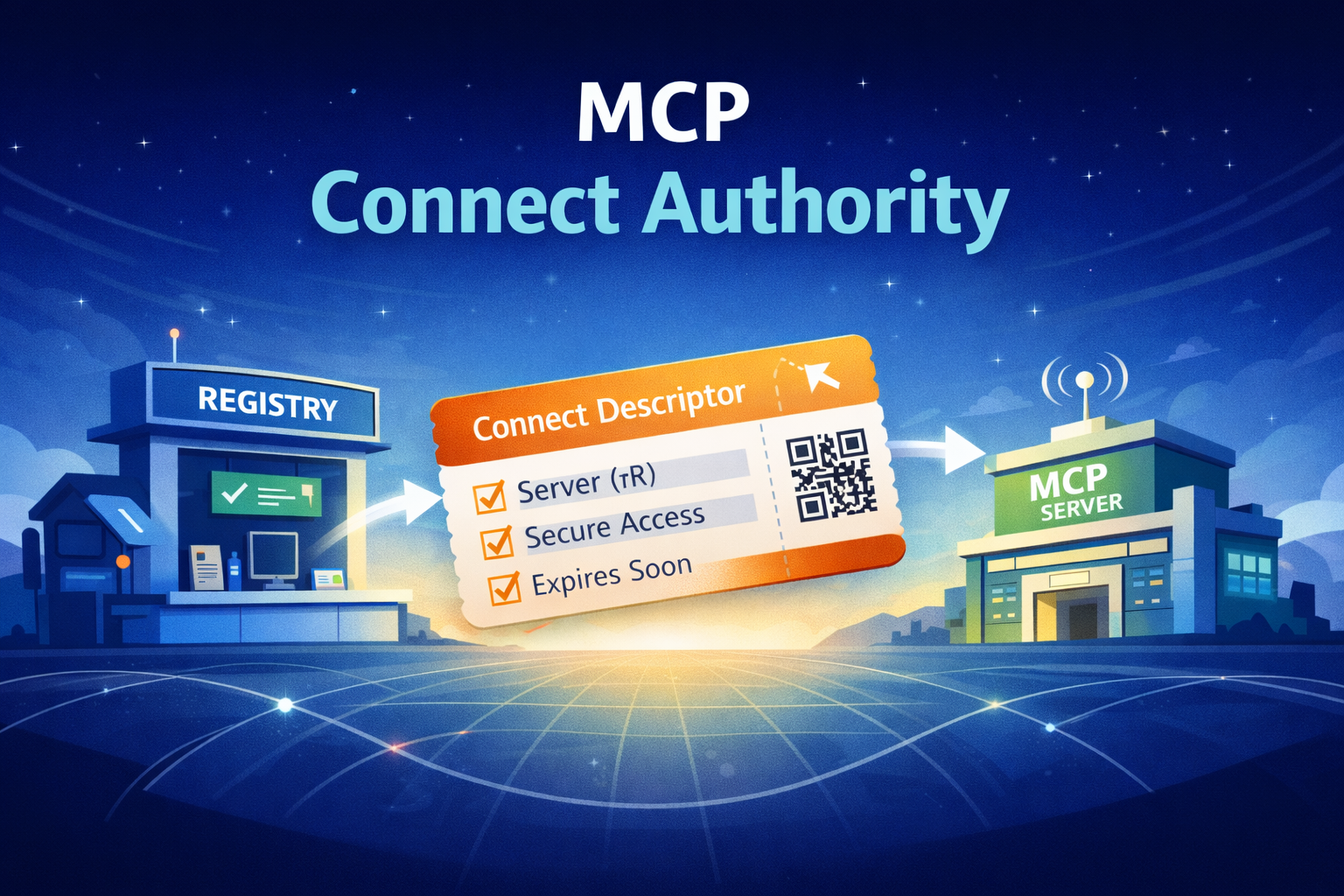
The MCP Connect Authority: A Zero Trust Architecture for AI

In the rapidly evolving landscape of the Model Context Protocol (MCP), architects are facing a critical decision: how to secure and govern connections between AI clients and a sprawling ecosystem of tools and data servers.
The traditional answer is a Gateway—a centralized proxy that inspects every byte. The modern answer is a Connect Authority—a distributed Zero Trust model that separates permission from traffic.
This detailed guide introduces the MCP Connect Authority architecture, a standard championed by HAPI to enable scalable, secure, and governed AI ecosystems without the bottlenecks of a central data-plane proxy.
The Architectural Shift
The instinct in microservices was often "put a gateway in front of it." In the world of decentralized AI agents and remote tools, however, forcing all traffic through a single pipe creates unacceptable latency, operational fragility, and a massive security target.
We argue for a cleaner architectural split:
- Control Plane (The Registry): Decides who connects.
- Data Plane (The Server): Enforces what happens.
By treating the MCP Registry as a Connect Authority, we remove the need for a gateway to ever see the traffic, while maintaining stronger governance than a gateway could ever provide.
The Core Concept: Permission ≠ Proxy
A Gateway is a data-plane bottleneck. It answers: "Let me route this packet for you." A Connect Authority is a control-plane enabler. It answers: "Are you allowed to connect right now?"
If the answer is yes, the Authority issues a Connect Descriptor—a digital "boarding pass" that allows the client to fly directly to the destination.
How it Works: The Connect Descriptor
The keystone of this architecture is the Connect Descriptor, primitives defined in the MCP Connect Authority Spec.
- Discovery & Auth: The Client asks the Registry for access to a specific tool or server.
- Issuance: The Registry acts as the Connect Authority. It checks policy, subscription status, and server health. If approved, it signs a short-lived Connect Descriptor (JWT).
- Direct Connection: The Client connects directly to the HAPI MCP Server using streamable HTTP, presenting the descriptor in the headers.
- Distributed Enforcement: The Server (not a gateway) validates the descriptor using the Registry's public keys and enforces runtime policies (rate limiting, user auth, logging).
Why This Wins: Authority vs. Gateway
Why move to this model? Because it aligns with Zero Trust principles while solving the practical scaling problems of AI agents.
| Feature | Traditional MCP Gateway | MCP Connect Authority |
|---|---|---|
| Traffic Path | Indirect (Client → Gateway → Server) | Direct (Client → Server) |
| Bottleneck | High (All data flows through one point) | None (Control plane traffic is tiny) |
| Failure Mode | Gateway down = System offline | Registry down = No new connects; existing work continues |
| Security | Centralized Honeypot (Sees all data) | Zero Trust (Registry sees no payload data) |
| Enforcement | Centralized Policy Engine | Distributed (Enforced at the edge) |
| Cost | High (Bandwidth & Compute) | Low (Signature generation only) |
Key Capabilities
1. Zero Trust by Design
In this model, network location means nothing. A client cannot connect to a HAPI server simply because it has the IP address. It requires a valid, time-limited cryptographic proof (the Descriptor) from the Authority. This is true Zero Trust MCP Architecture.
2. Runtime Effective Moderation
"Governance without a gateway" sounds like a paradox, but it is achieved through specific mechanics:
- Short TTLs: Descriptors expire in 30-120 seconds.
- Refresh Enforcement: Servers can force clients to refresh their descriptors.
- Instant Revocation: If a server is compromised or policy changes, the Registry simply stops issuing descriptors. The "hard shutoff" happens immediately at the next refresh interval.
3. Scalability (Social and Technical)
Technically, this removes the single point of failure and latency of a proxy. Socially, it allows the ecosystem to scale. A central Registry can govern thousands of independent servers without needing to host or route their traffic. It is the only viable path for a global, federated MCP ecosystem.
Reference Implementations
The HAPI ecosystem is building this standard today.
- HAPI MCP Registry: Acts as the Connect Authority, implementing the
POST /v1/connectendpoint. - HAPI MCP Servers: Native support for validating Connect Descriptors and enforcing distributed policy.
- MCP Clients: Updated SDKs that support the "Get Descriptor → Connect" flow seamlessly.
Conclusion
You don't need a gateway to have governance. You need Authority.
By adopting the MCP Connect Authority model, we move past the brittle, centralized proxy architectures of Web 2.0 and embrace a decentralized, secure, and performant standard for the Agentic AI era.
Be HAPI. Governance is solved.