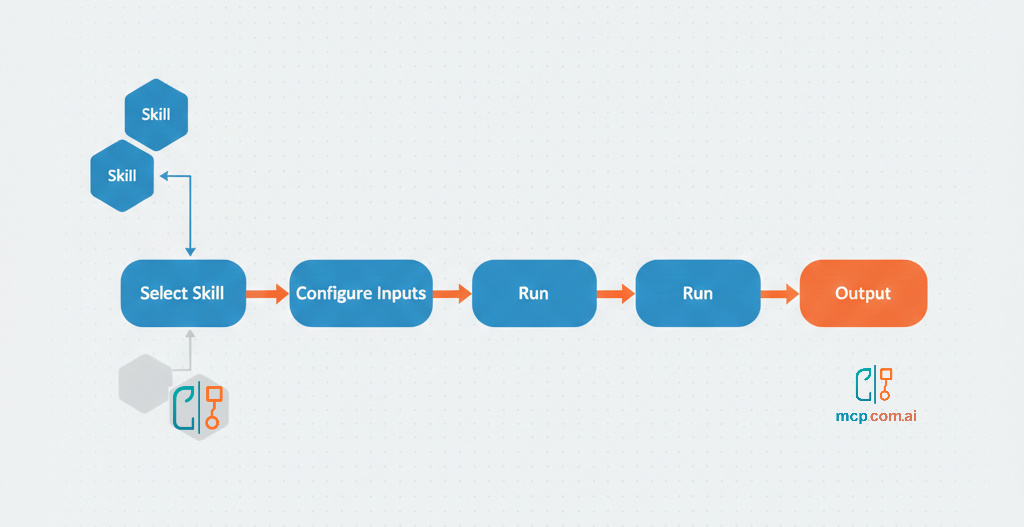
Mastering Skills: Your Gateway to Enhanced AI Capabilities

In the rapidly evolving landscape of AI, Skills have emerged as a transformative force, enabling developers to extend the capabilities of AI models far beyond their native functions. Whether you're building chatbots, virtual assistants, or complex AI-driven applications, mastering Skills is essential to unlocking new levels of performance and user engagement.
Where agents stop guessing — and start acting
AI agents don’t fail because they’re not smart.
They fail because they don’t know what they’re allowed to do.
Skills are the missing layer between reasoning and execution.
They turn vague prompts into explicit, auditable, testable actions.
This section is the home of everything you need to understand, design, and operationalize Skills using the Model Context Protocol (MCP).
What are Skills?
A Skill is a structured, declarative capability that an AI agent can invoke safely and deterministically.
Think of a Skill as:
- A contract, not a prompt
- A capability, not a suggestion
- A tool with boundaries, not a magic trick
At a technical level, a Skill is:
- Defined using MCP
- Exposed as a tool with a clear schema
- Executed by systems, not the model itself
Reasoning stays with the model.
Authority stays with the system.
Why Skills exist (and prompts are not enough)
Prompt-only agents break at scale.
They:
- Hallucinate actions
- Overreach permissions
- Leak secrets
- Fail silently
- Cannot be audited, tested, or governed
Skills exist to solve that.
They allow you to:
- Explicitly declare what an agent can do
- Control how and when execution happens
- Separate decision-making from authority
- Build agents that pass security, compliance, and platform reviews
If prompts are thoughts, Skills are hands.
Skills are not plugins. Not functions. Not workflows.
Skills are often misunderstood.
They are not:
- Plugins (too UI-driven)
- Functions (too low-level)
- Workflows (too rigid)
Skills live in between.
They are:
- Composable
- Discoverable
- Context-aware
- Governable
This is why MCP matters: it gives Skills a standardized, machine-readable contract that works across:
- IDEs
- Agents
- Runtimes
- Enterprises
- Air-gapped environments
What you’ll learn in this section
This Skills section is not a tutorial dump.
It’s a mental model + execution guide.
Here you’ll learn how to:
🔹 Design Skills
- How to think in capabilities, not endpoints
- How to model inputs, outputs, and constraints
- How to avoid over-privileged Skills
🔹 Build Skills
- API-to-MCP (a2m) Skill patterns
- Tool schemas that scale
- Error handling for agents (not humans)
🔹 Test & Evaluate Skills
- Skill evaluation (mcp-eval)
- Deterministic vs probabilistic behavior
- Guardrails, contracts, and failure modes
🔹 Deploy Skills
- Local vs remote MCP servers
- Enterprise-ready Skill exposure
- Air-gap and zero-trust patterns
🔹 Govern Skills
- Skill registries
- Versioning and deprecation
- Security reviews and auditability
Who this section is for
This section is written for people building real systems, not demos.
- Platform teams defining agent capabilities
- API teams turning services into agent-ready tools
- Security teams asking “what can this agent actually do?”
- Product leaders trying to ship AI features without chaos
- Builders who want agents that survive production
If you’ve ever asked:
“How do we control what the agent can do?”
You’re in the right place.
Skills are the unit of scale for agents
Agents don’t scale by being smarter.
They scale by being better constrained.
Skills are:
- The unit of execution
- The unit of security
- The unit of governance
- The unit of enterprise adoption
This section exists because Skills are not optional anymore.
They are the foundation.
Start here
If you’re new:
- Read What is a Skill?
- Then API → MCP Skills (a2m)
- Then Skill Evaluation & Safety
If you’re advanced:
- Jump straight to Skill Lifecycle Management
- Or Enterprise Skill Architectures
Either way — welcome.
This is where agents become systems. Be HAPI, and Go Rebels! ✊🏼